What Martial Art Should I Learn First for MMA?
Sep 26, 2026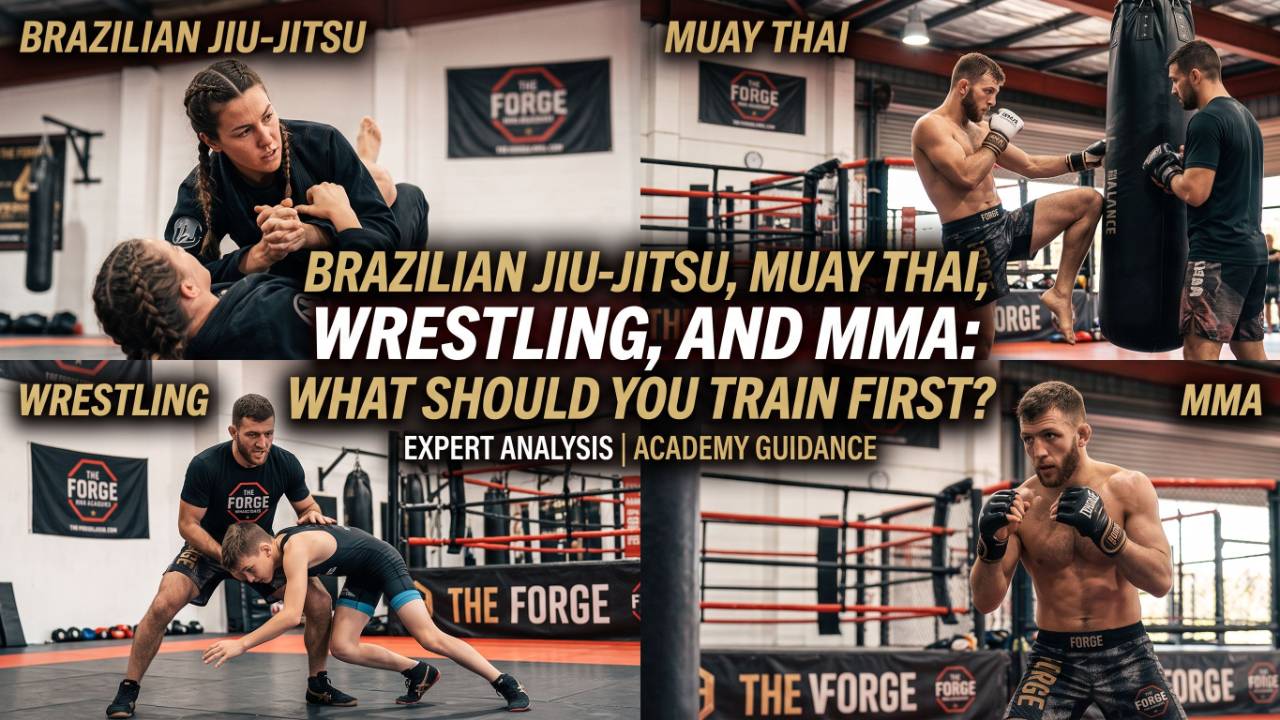
Brazilian Jiu-Jitsu, Muay Thai, Wrestling, and MMA: What Should You Train First?
Mixed martial arts combines several combat sports into one complete system. That is part of what makes MMA exciting, but it can also make it confusing for beginners.
Should you start with Brazilian Jiu-Jitsu? Muay Thai? Wrestling? Boxing? Or should you begin with MMA classes right away?
The best answer depends on your goals, but understanding how each style fits into MMA can help you make a smart choice.
What Brazilian Jiu-Jitsu adds to MMA
Brazilian Jiu-Jitsu, often called BJJ, focuses on ground fighting, control, escapes, submissions, and leverage.
BJJ teaches you how to:
- Escape bad positions
- Control an opponent on the ground
- Use guard positions
- Defend submissions
- Apply chokes and joint locks
- Stay calm under pressure
- Use technique against strength
For MMA, BJJ is important because many fights end up on the ground. Even if you prefer striking, you need to know how to survive, escape, and defend submissions.
BJJ is also useful for self-defense because it teaches control without relying only on strikes.
What Muay Thai adds to MMA
Muay Thai is a striking art from Thailand that uses punches, kicks, knees, elbows, clinch work, and sweeps.
Muay Thai teaches you how to:
- Strike with power
- Use kicks effectively
- Defend strikes
- Control distance
- Fight in the clinch
- Use knees and elbows
- Stay balanced while attacking
For MMA, Muay Thai is valuable because it develops strong stand-up skills and clinch awareness. However, Muay Thai for MMA must be adapted because takedowns change the way you stand, strike, and defend.
What wrestling adds to MMA
Wrestling is one of the most important foundations in MMA.
Wrestling teaches you how to:
- Control where the fight happens
- Defend takedowns
- Finish takedowns
- Maintain top pressure
- Scramble back to your feet
- Hand fight and control positions
- Build balance and toughness
In MMA, wrestling often decides whether a fight stays standing or goes to the ground. Even basic wrestling defense can make a major difference for beginners.
What boxing adds to MMA
Boxing focuses on punches, footwork, head movement, defense, timing, and combinations.
Boxing teaches you how to:
- Throw clean punches
- Move efficiently
- Defend with guard and head movement
- Build combinations
- Manage range
- Counterattack
- Stay relaxed under pressure
Boxing is essential for MMA, but it also needs adjustment. MMA gloves are smaller, kicks and takedowns exist, and certain boxing stances can create takedown or leg kick openings.
Should beginners start with one style or MMA?
Both options can work.
Starting with one style helps you build depth. For example, BJJ can give you a strong grappling base, while Muay Thai can build striking confidence.
Starting with MMA helps you understand how the pieces connect. You learn early that striking affects takedowns, takedowns affect grappling, and grappling affects striking.
For many beginners, the best path is a mix:
- Take MMA classes to understand the full game
- Add BJJ to improve ground skills
- Add striking classes to improve stand-up
- Add wrestling or takedown work when available
- Build conditioning alongside technique
This approach helps you become well-rounded without getting lost.
If your goal is fitness
If your main goal is fitness, you can start with MMA, kickboxing, or BJJ.
MMA and striking classes often provide higher cardio intensity. BJJ builds strength, mobility, and problem-solving under pressure. Both can help you get in shape while learning practical skills.
Choose the class you enjoy enough to attend consistently.
If your goal is self-defense
For self-defense, a combination of striking, takedown defense, and grappling is best.
You want to know how to:
- Create distance
- Defend strikes
- Stay on your feet when possible
- Escape holds
- Get up from the ground
- Control an attacker if needed
- Stay calm under stress
MMA training is useful because it blends these areas together.
If your goal is competition
If you want to compete in MMA, you need a complete skill set.
That means training:
- Striking for MMA
- Wrestling and takedown defense
- BJJ and submission grappling
- Clinch work
- Cage or wall work when available
- MMA-specific conditioning
- Controlled sparring and live rounds
Competition training should be guided by experienced coaches. Do not rush into fighting before your fundamentals are ready.
What should you train first at The MMA Academy?
If you are brand new, start with beginner-friendly MMA classes and ask the coaches where to focus next.
Your coach may recommend extra work in striking, grappling, or conditioning based on your goals and current skill level.
The important thing is not choosing the perfect style on day one. The important thing is starting with quality instruction and building consistently.
Complete MMA comes from connecting the pieces
BJJ, Muay Thai, wrestling, and boxing each bring something valuable to MMA. None of them replace the others. The most effective martial artists learn how to connect them.
At The MMA Academy, students train practical skills in a structured environment so they can become more confident, capable, and well-rounded.
If you are unsure where to begin, start with a trial class and let the coaches guide your next step.
Book a free trial class